

Jun 11, 2026
Research
System Modeling: The Substrate for Neural Co-Evolution
“Every Model is Wrong, But Some Are Useful”
A few weeks ago, Formula One world champion Lewis Hamilton had a very bad race. In modern F1, drivers don’t actually get to spend that much time training on the physical track, and cars change so much from race to race that trying to learn their new dynamics in a few laps is impossible. So, drivers spend days in driving simulators that are meant to be ‘digital twins’ of how the car and the track behave together. Lap after digital lap, they integrate the track and the car’s dynamics into their muscle memory.
Hamilton did this. He prepped, he practiced, and then he went to the real track and had a terrible day.
When they interviewed him after the race, he blamed the simulator. He complained about the lack of correlation between his simulation and his actual F1 car. It occurred to me then: he hadn’t driven poorly; he had learned the wrong car. The other F1 teams also use simulators, and presumably their simulators were also wrong, just less wrong. All models are wrong, but some are useful.¹ Even little errors when simulating dynamical systems lead to poor results.
When you are trying to simulate a highly sensitive physical system, correlation is everything. It makes or breaks you.
A racing simulation is a ‘digital twin’ of a system composed of the car and the track. Simulations have been around forever, but recent advancements in scientific computation techniques and capacity have seen their wide adoption in accelerating development of complex and novel systems ranging from fusion reactors to pharmaceuticals.
At Unconventional AI, just about everything we do is ‘novel and complex’, and leveraging digital twins is an integral part of our strategy.
Computing at the Edge of Chaos
The digital twins needed by Unconventional AI are especially challenging because we are designing systems inspired by the brain, and brains like to be (almost) chaotic.
Biological neural networks have evolved over billions of years to optimize intelligence-per-joule. Studies strongly suggest that the brain maximizes this capability by operating at the ‘edge of chaos’. If all your neurons fire in perfect unison, it’s boring—no real computation happens. If they fire completely randomly, it’s chaotic and equally useless. The real computation happens when brains are right on the boundary between those two states.²
That boundary – the edge of chaos – is highly complex. It is also where messy, non-linear dynamics become incredibly expressive. Because our goal is to increase computational efficiency by 1000x, our hardware must embrace and harness these near-chaotic behaviors.
Our challenge is to simulate our hardware designs with enough fidelity to be able to accurately model behaviors when on the verge of chaos.
The Double Pendulum Proxy
To understand the challenges of simulating near-chaotic systems, let’s look at a classic museum toy: the double pendulum. Admittedly, this is a ’toy’ proxy in that it is much more prone to chaotic behavior than large collections of neurons or well-designed analog circuits are, but it’ll do.
A double pendulum is a pendulum with a second joint in the middle. This simple addition creates a system that loves to be chaotic. Tiny differences such as how you start the pendulum swinging, small vibrations in its mount, and even slight drafts of air, all lead to completely different outcomes.
Accounting for Non-Ideal Physics
While a lot of discovery can happen with ideal models, you eventually need to correlate with the real world (just ask Sir Hamilton). When our system modeling team creates a digital twin, we have to model physical reality, which is fraught with “non-idealities” like friction (or in circuits, noise, unintended couplings, drift, and more).
For example, if we simulate a frictionless (Ideal) double pendulum alongside one damped by friction (more “Real”), starting from the exact same initial conditions, they swing in sync for a moment before wildly diverging. The change from ‘almost matching’ to ‘wildly diverging’ happens around what we call the ‘onset of chaos’.
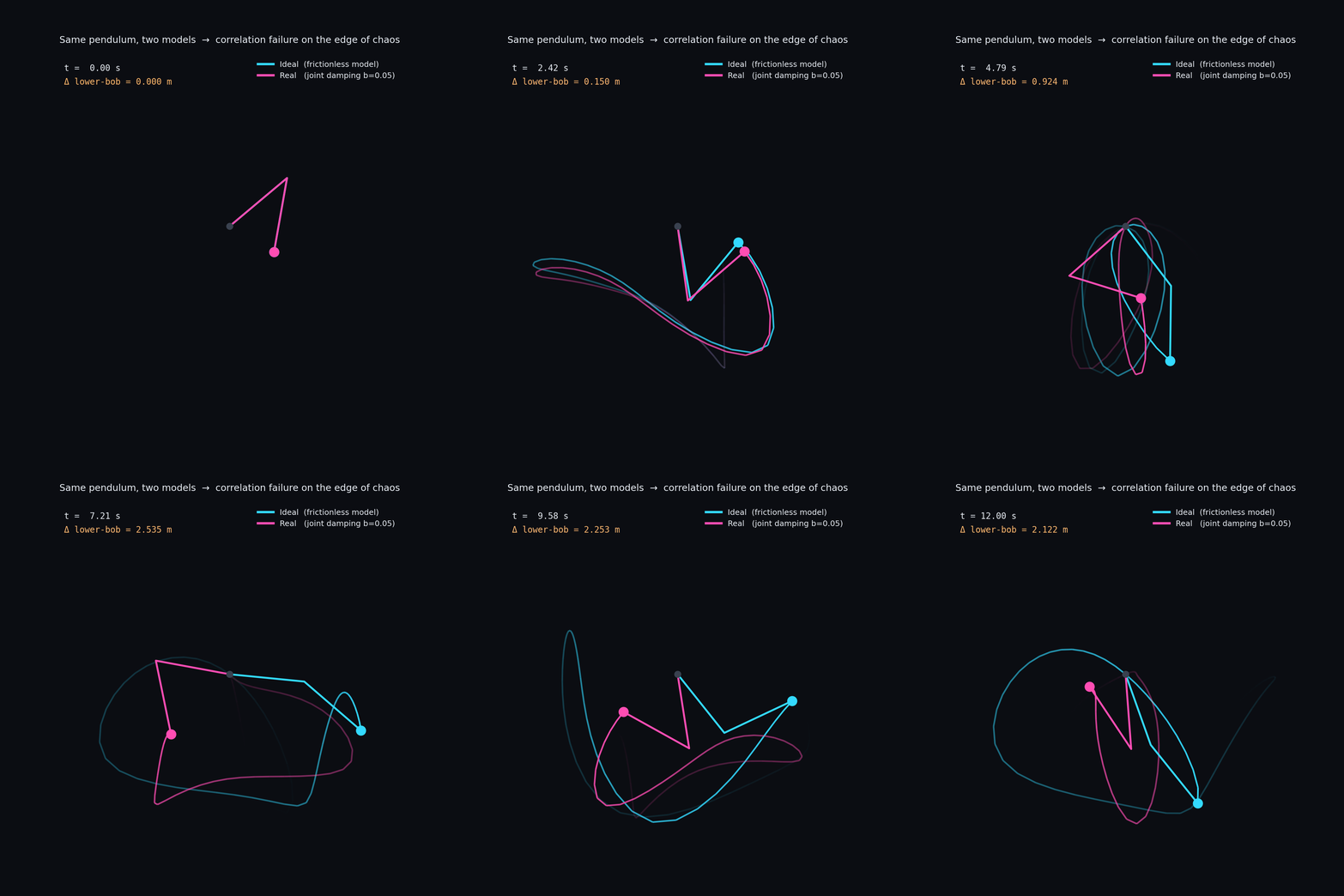
This divergence is very telling to system modelers: if we fail to account for physical non-idealities, our digital twins will rapidly diverge from reality. This gets even worse when we look at the actual chaotic boundaries, which is where a system is right on the verge of transitioning from ordered to chaotic behavior. For dynamic systems, the edge between these regions is fantastically complex, and worse yet, it doesn’t behave well when non-idealities and numerical errors are introduced.
Mapping the Chaos
To illustrate this, we can create a ‘chaos map’ where every point represents the starting conditions for our pendulum. Since it has two joints, this plot is fairly simple: the X axis corresponds to the starting angle of one joint, and the Y the other. We can then simulate the behavior of a pendulum starting from those initial conditions, and use colors to indicate if and how quickly it transitions to chaos. In the graph below, we can find the regions that are boring (the pendulum just rocks back and forth, colored ‘black’) and the regions that are decidedly chaotic (one of the joints flips completely over, which we use as a proxy for impending chaos). It’s the boundary between those two that is of greatest interest to us – note how intricate the interface is.
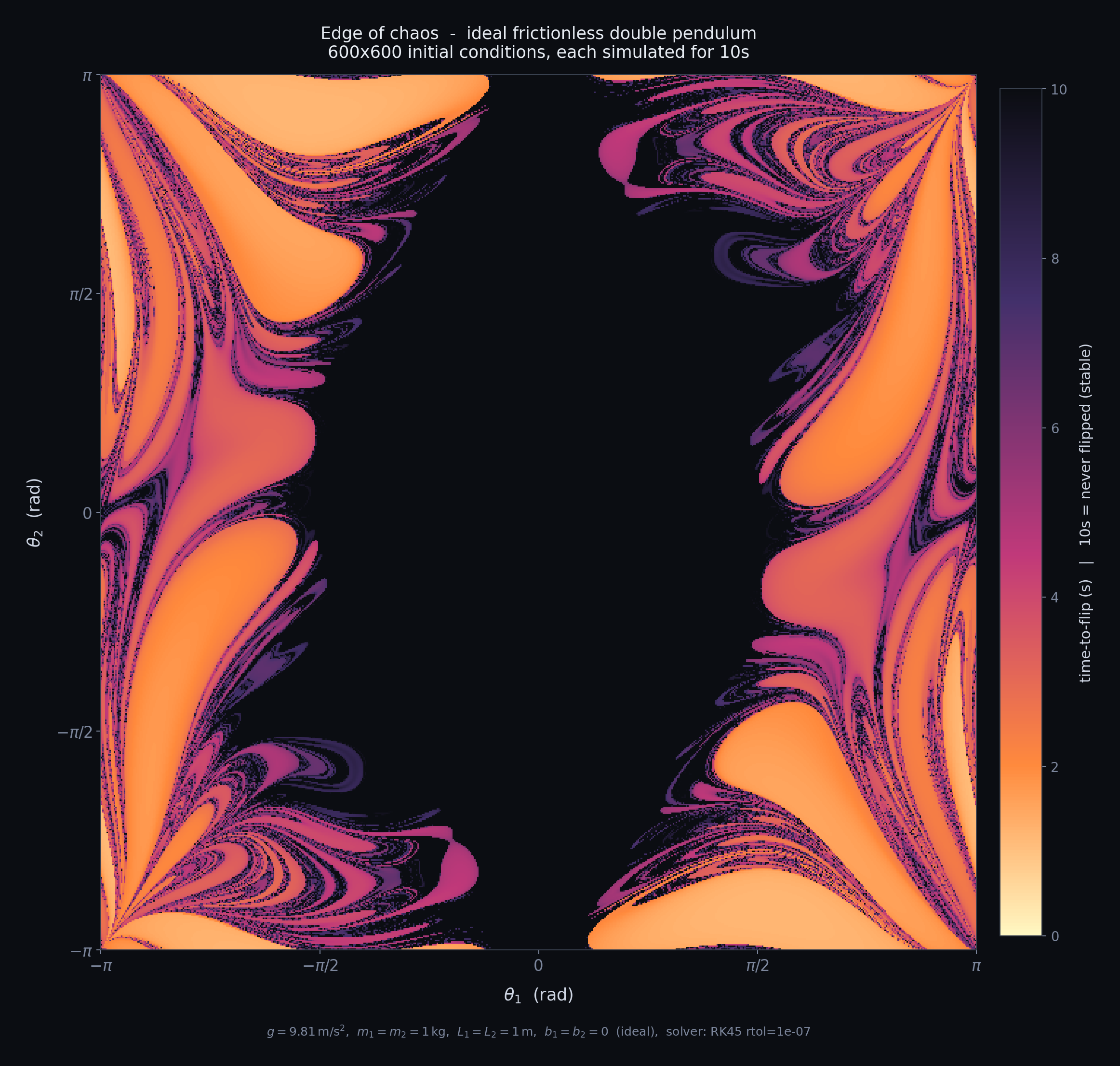
Chaotic, non-chaotic, and the boundary between them.
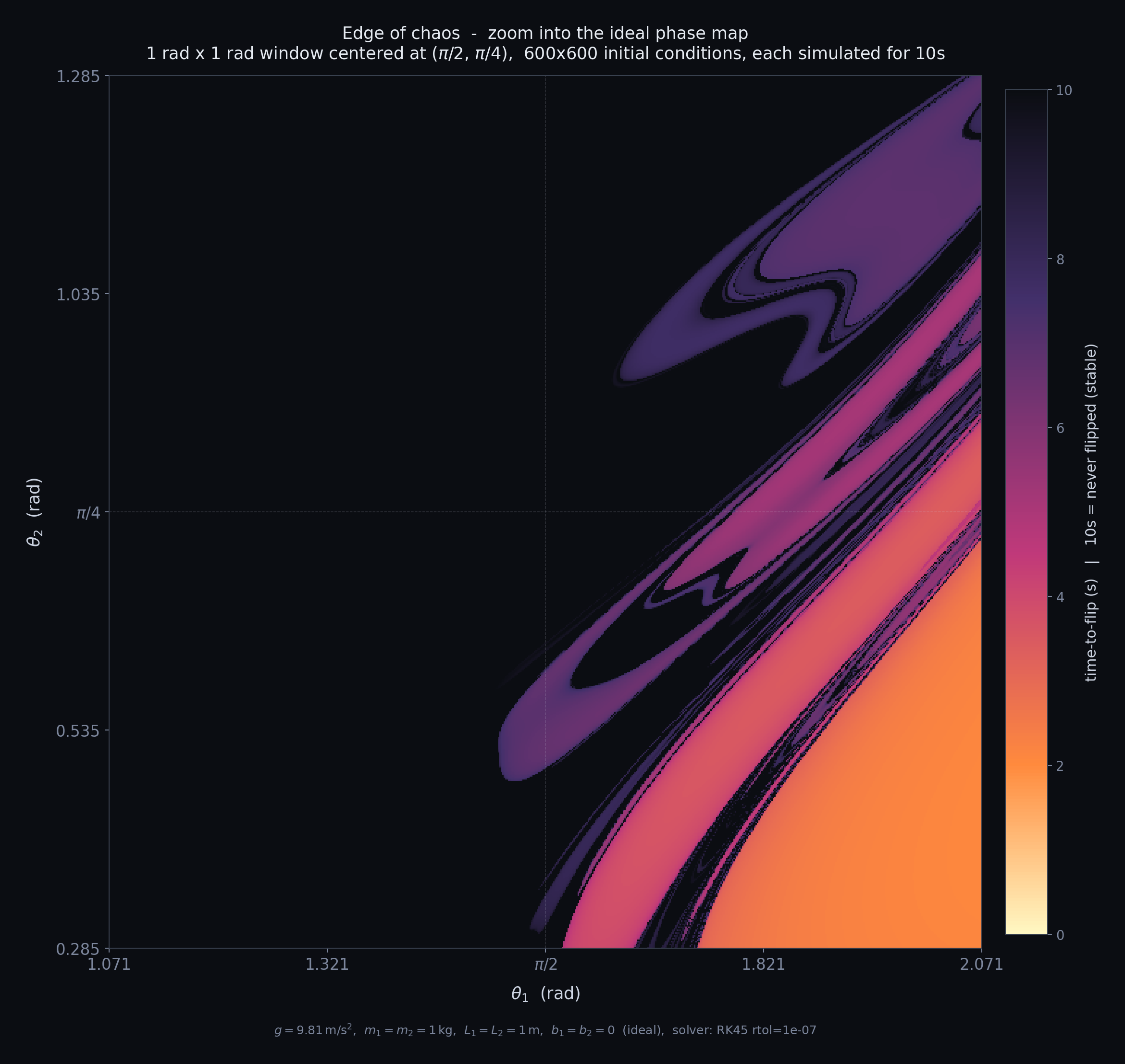
Zooming in to the Edge of Chaos, where cool things happen…
A Slice of Chaos
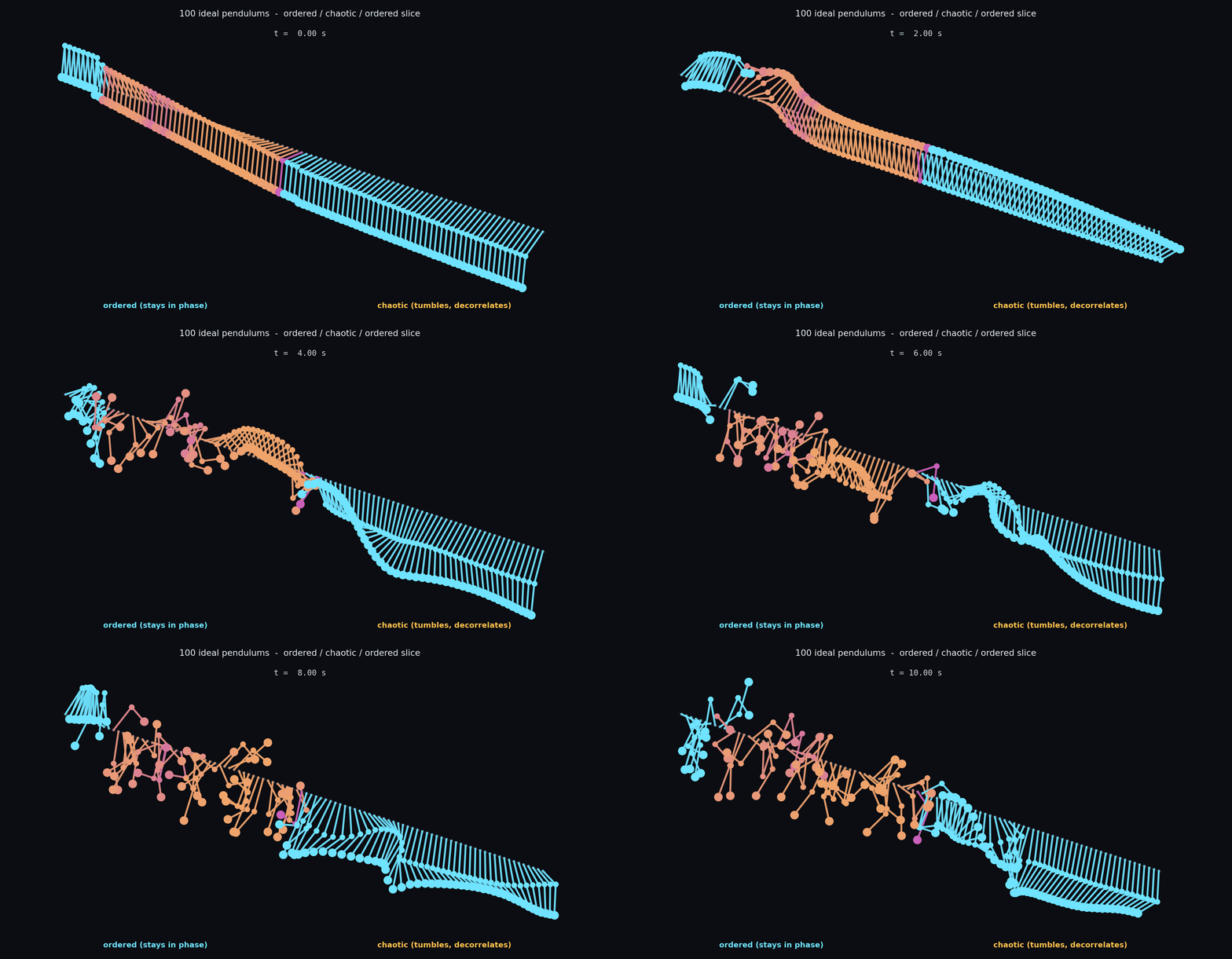
It might be hard to really understand what these chaos maps mean, so let’s illustrate by animating a ‘slice’ of pendulums through a chaotic region. In the animation, note how the orange regions slide into chaos quickly in the simulation. Astute observers might note that some of the teal ‘ordered’ regions seem to be heading towards chaos too – this is a common behavior in these systems: over short time horizons, things tend to be well-ordered, but over longer time periods, chaos may arise. In this simulation, we only let about 10 seconds pass. Neural systems operate on the order of nanoseconds, or even femtoseconds – one advantage neural systems have is that they don’t have to be near-chaotic forever, we only need them predictable for as long as it is useful to our computation.
Adding a Trivial Non-Ideality
Even adding a small non-ideality like ‘joint friction’ changes the chaotic boundary in incredibly complex, non-intuitive ways. The diagram below shows two ‘chaos maps’, one based on ideal physics, and one with a touch of friction. Note how most of the behavior seems relatively unchanged: regions that were ordered still look ordered, and those that were chaotic are still chaotic. The problem for system modelers is in difference between the ideal model and the real model’s ‘chaos boundary’; the third panel highlights the delta between the two, and notably, the delta is largest where the physics are the most expressive.
If our AI models are trained on the “Ideal” simulation, they might try to exploit an expressive near-chaotic region that, in physical reality, doesn’t actually exist.
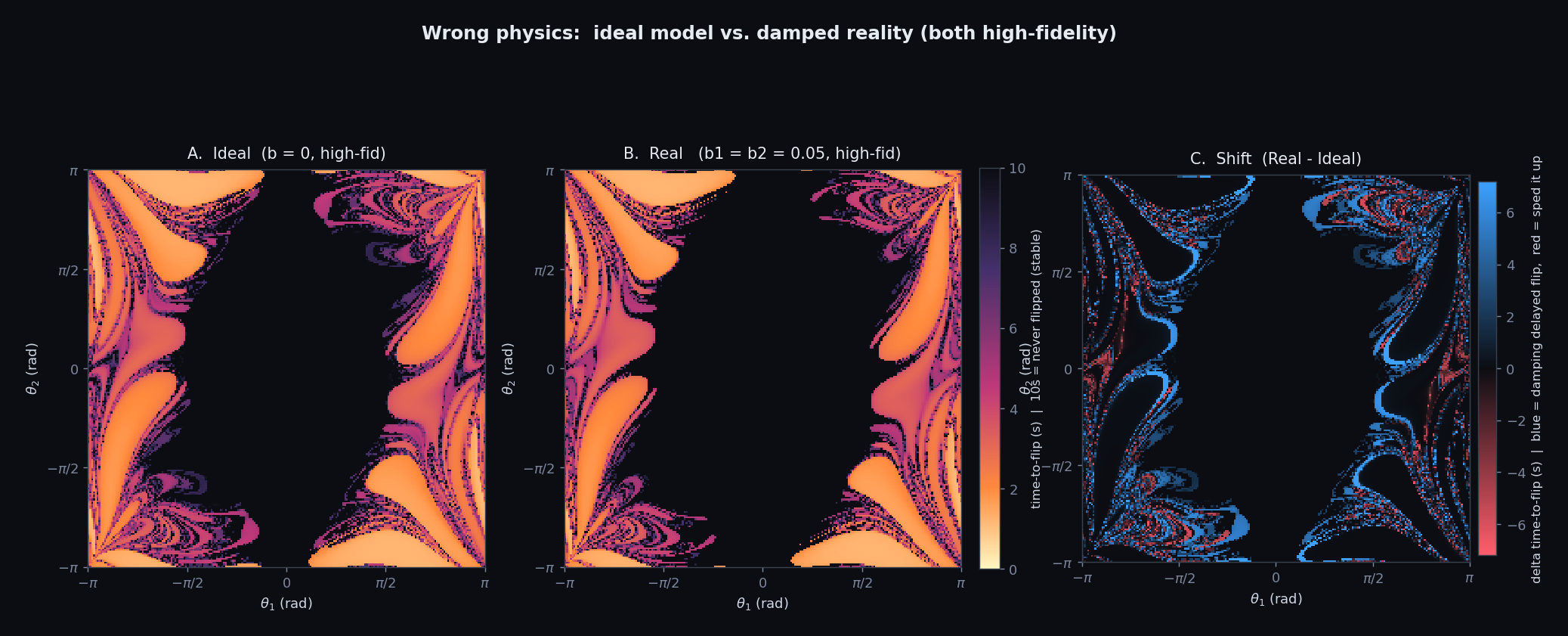
Note that friction is just the beginning – if we wanted to accurately model a physical double-pendulum, we’d need to add the weight and distribution of the rods, air resistance, joint momentum, and more. In high school you learned that you only had to pay attention to the first few decimals. In near-chaotic modeling, the good stuff hides in that boundary between predictable and unpredictable, and needs a lot more decimal places to get right.
We’ve all heard about the butterfly effect – this ‘chaos boundary’ is where those butterflies live. At Unconventional, we are effectively herding butterflies to get their collective fluttering to do useful computational things. This is (as engineers like to say) non-trivial, and it requires butterfly-flutter-level accuracy.
The Numerical Butterfly Effect
It isn’t just physical non-idealities that can break correlation; numerical approximation will wreck it, too.
Because we cannot solve these complex dynamic equations analytically, we must approximate them numerically. If we use a low-fidelity numerical solver (like a coarse Euler method) instead of a high-fidelity one (such as a high-order DoPri), the mathematical rounding errors act just like highly non-linear physical perturbations.
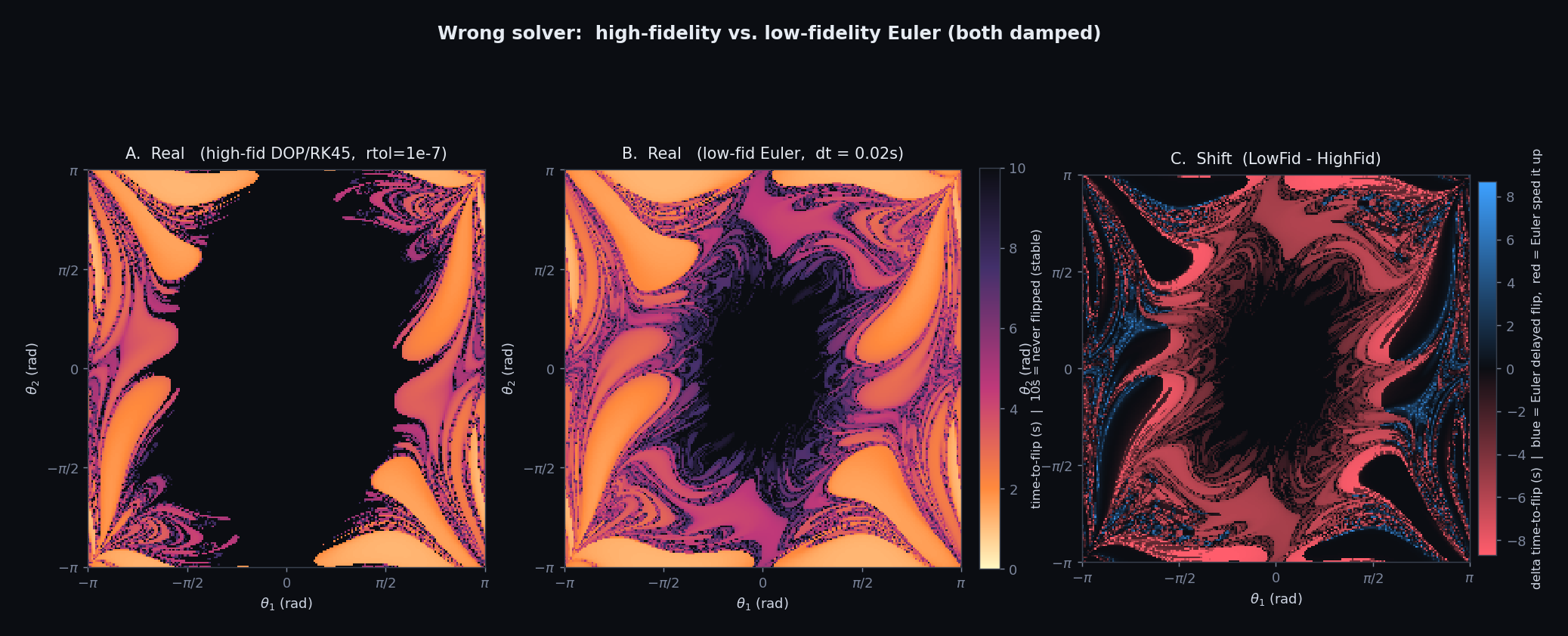
As you can see, near the chaotic edge, low-accuracy numerics completely blow out the boundaries of the system. If our numerics aren’t tight, near-chaos correlation to the real silicon is lost entirely.
“Every Model is Wrong, But Some Are Useful” Redux
So, we need high-fidelity to the physical reality, and high computation accuracy.
Except… fidelity is hard to compute, and there are engineering limits to what is feasible. If we make the simulation perfectly accurate, it takes hours to run, and AI scientists need to run millions of passes. The System Modeling team is obsessed with this problem: finding the right physical abstraction, solvable using the right numerics, and doing all of it fast enough that you can run thousands of AI training experiments before the heat death of the universe.
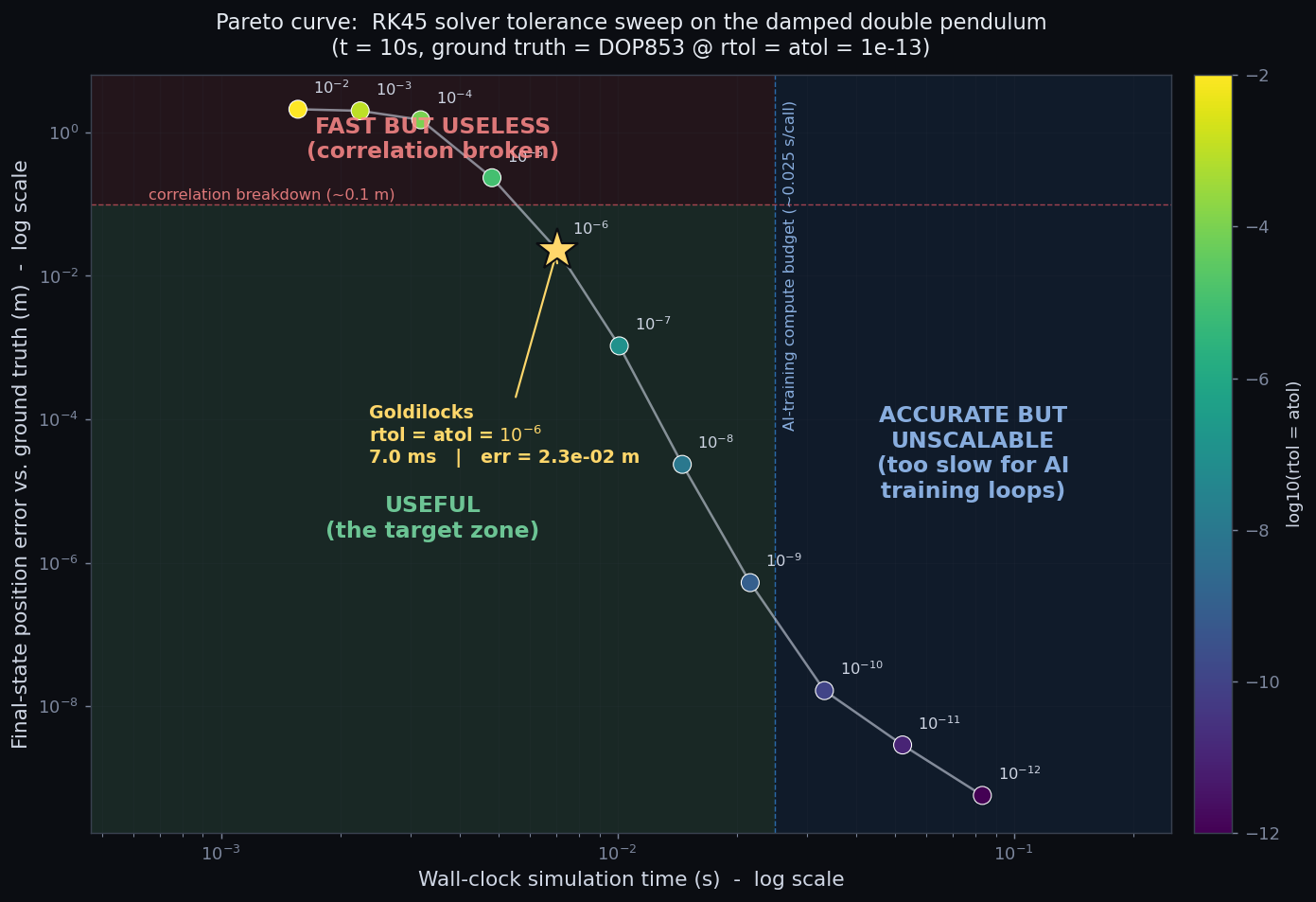
The secret isn’t perfection; it’s the useful abstraction. We have to find the “Goldilocks” zone – the exact level of abstraction that is useful, rather than fast but useless or accurate but unscalable.
The Substrate for Neural Co-Evolution
This balance is critical to our success here at Unconventional AI. We call our core methodology Neural Co-evolution: the idea that our AI scientists, AI theorists, and silicon engineers are all working together to co-design everything.
These physical models are the crucibles where hardware and software are forged together. By finding the right abstraction layer, we ensure our AI training results correlate with our physical chips, opening a path for us to realize our goal of 1000x power savings.
Does herding chaotic fluttering butterflies via ultra-high-performance high-fidelity numerical techniques sound interesting to you? If you have a passion for circuit physics, simulation, and speed, you belong to a very small Venn diagram, and boy do we have a job for you. Apply on our careers page and help us build the new physical substrate for intelligence.